
Pizza box style design with just locks on one side and do not require glue for locking. Based on FEFCO 0429 box standard
A self locking box is a single-piece folding carton that assembles without glue, tape, or staples. The structure uses pre-cut side flaps that interlock to hold the box rigid. Once folded, it stays closed under normal handling without any adhesive.
This specific design is based on FEFCO 0429 — a pizza tray style structure where the locking mechanism sits on one side only. That makes it faster to assemble than a full four-sided lock and easier to open for the end user.
Self locking boxes are popular in retail, cosmetics, food packaging, and small product shipping. They work well for soap, candles, and skincare products, small electronics and accessories, craft and handmade goods, corporate gifting and welcome kits, and short run packaging where speed of assembly matters.
The no-glue design is particularly useful for small businesses and makers who are hand-assembling packaging without industrial equipment.
The generator lets you set your own length, width, height, number of locks, lock width, lock distance, and flap width. All dimensions are internal by default — meaning the box interior matches exactly what you enter.
Material thickness is accounted for separately so your product always fits correctly whether you're cutting from 1mm cardstock or 3mm corrugated board.
This box will not work well if your material thickness is high and dimensions are very small, like around 50mm. In that case, we recommend using either a tube lock box or a tuck end box.
Three formats are available to download:
SVG — works with Cricut, Silhouette, and most laser cutter software. Clean vector paths, no cleanup needed.
PDF — ready to print on A4 or A3 for prototyping or manual cutting. Good for testing dimensions before going to production.
DXF — compatible with AutoCAD, CorelDRAW, and CNC cutting machines. Cut lines and crease lines are on separate layers so your CAM software picks them up correctly without any manual sorting.
If you need a full four-sided lock the Self Locking Mailer Box based on ECMA A10.20.03.01 is worth looking at. For a simpler open tray style the Folding Box based on FEFCO 0427 is a good alternative. If you need extra strength for heavier products the Heavy Duty Box based on FEFCO 0201 handles more weight without compromising on the no-glue assembly.
Product | Length | Width | Height |
|---|---|---|---|
Soap bar | 90mm | 60mm | 30mm |
Pillar candle | 80mm | 80mm | 80mm |
Jewellery / earrings | 100mm | 80mm | 25mm |
Skincare tube / rollerball | 120mm | 45mm | 45mm |
Cable / earbuds | 150mm | 90mm | 40mm |
Small cosmetics | 110mm | 70mm | 35mm |
The most common mistake people make with this box is cutting the locks too tight. If your lock width is too small relative to your flap width the box either won't close properly or will tear on the first assembly. A good rule of thumb is to keep lock width at around 20-25% of your box length.
The second thing that trips people up is material thickness. People enter 0 or leave it blank thinking it doesn't matter for a small box. It does. Even 0.5mm difference on a small jewellery box will make the lid sit proud or not close flush. Always measure your actual material before entering dimensions.
Fold your crease lines before trying to assemble. Run a bone folder or the back of a butter knife along every crease first. Cardstock that isn't pre-creased will crack or buckle on the fold especially in dry conditions.
For most retail and gifting applications 300-350gsm cardstock hits the sweet spot. It's stiff enough to hold the lock without being so thick that the folds crack. Anything below 250gsm tends to feel flimsy and the locks don't grip well.
Kraft paper works beautifully for a natural handmade aesthetic but stick to 300gsm minimum. Thinner kraft tears at the lock points after a few open and close cycles.
Corrugated board works with this design but only single wall E-flute or F-flute. Anything thicker and the fold allowances become unpredictable. If you're going corrugated enter your material thickness accurately, usually 1.5mm for E-flute, and do a test cut before committing to a full production run.
Glossy coated stock looks premium but scores and folds less cleanly than uncoated. If you want a glossy finish consider printing on uncoated and laminating after cutting rather than cutting pre-laminated stock.
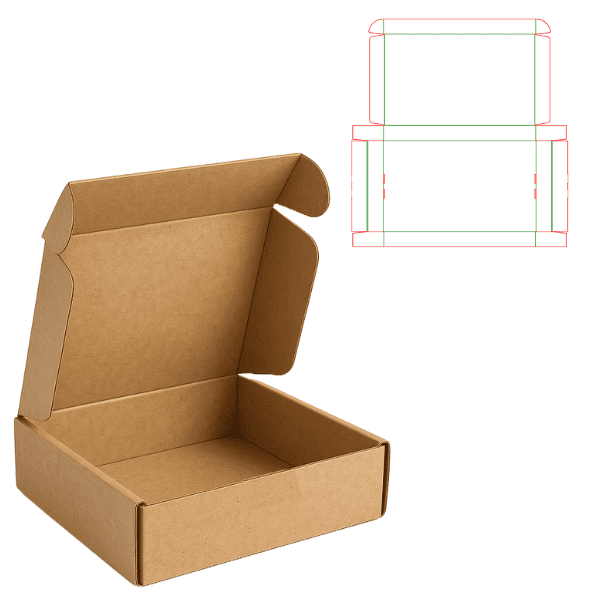
Glue-free folding box dieline based on FEFCO 0427. Download SVG, PDF or DXF. Generate high precision parametric dieline.
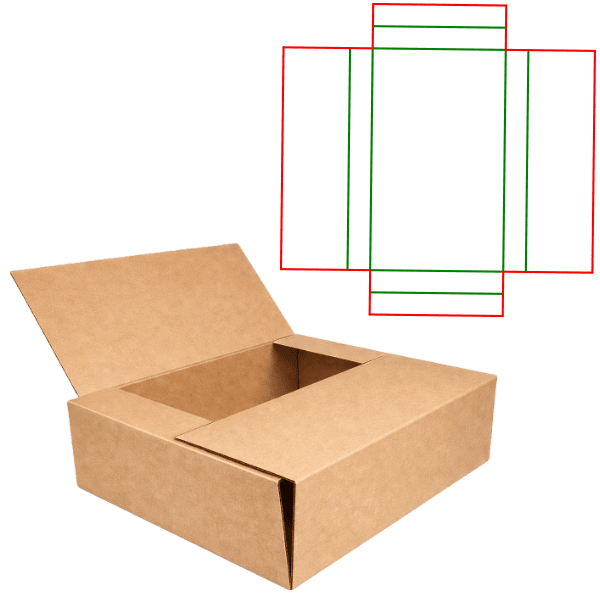
Best for packaging flat items that you want tight and good fit.
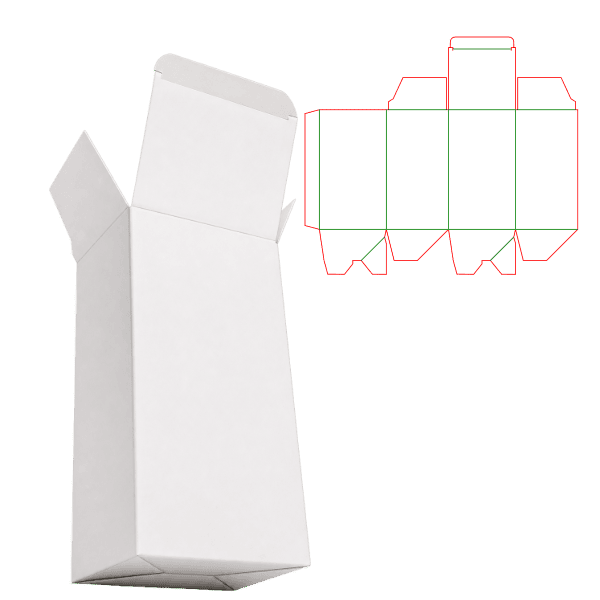
The fast one — a pre-glued base that snaps open and locks flat, so packing takes seconds not minutes.
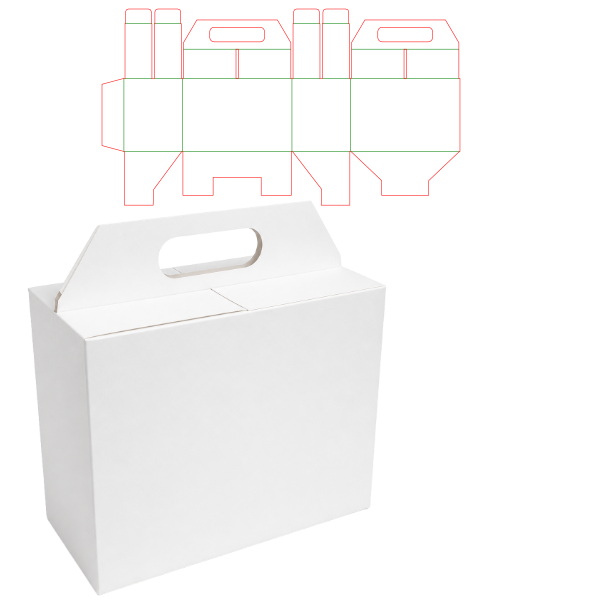
The cute one — a carry box shaped like a mini suitcase, with a handle and a base that snaps flat.